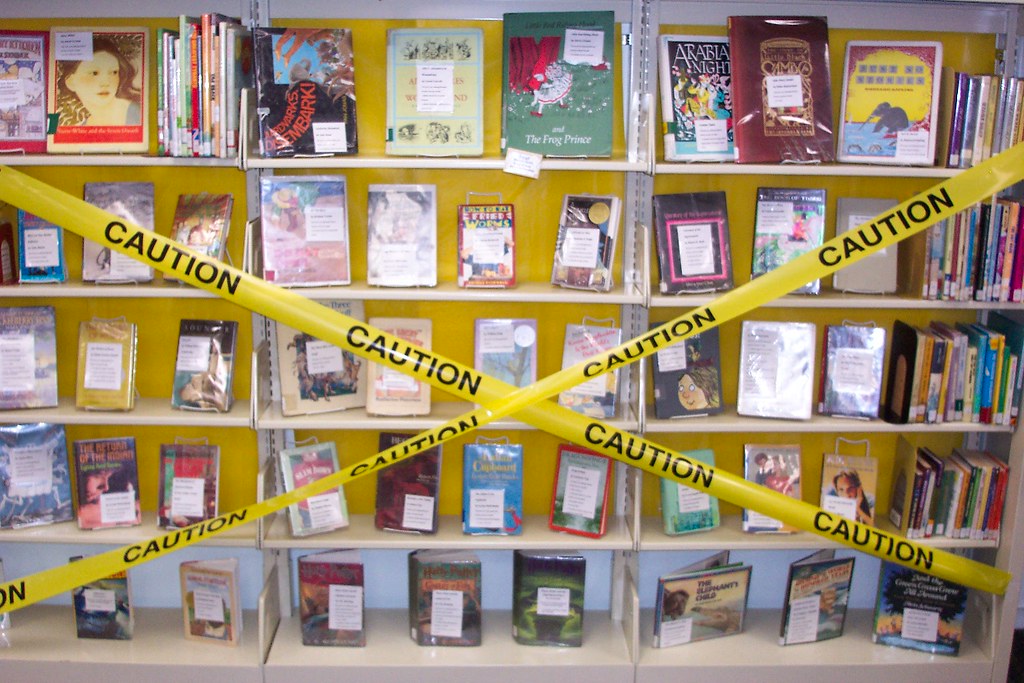
“There is more than one way to burn a book. And the world is full of people running about with lit matches.”
– Ray Bradbury, Fahrenheit 451 (50th Anniversary Edition)
Information is the most valuable resource in our modern world. In the hands of our leaders, the truth can be moulded or even obscured to create information that moves the public in the direction they desire. And the most important chunk of the public to influence is always the youngest, whose minds are still shaping around the knowledge being handed to them.
The term ‘book ban’ refers specifically to the removal of certain books from school libraries as well as curriculums. The reasons behind these bans vary, from concerns over depictions of violence or even mild swearing, to obscuration of certain ‘political ideals’. So, while a banned book may not necessarily be nationally made illegal to read, it does still mean that they are no longer accessible to those that are unable to buy their own books or read at home.
Here in the UK, reports surrounding book bans are nowhere near as prominent as in the US. In the last decade, we have seen new lists of banned books in US schools and libraries every single year; in 2025 many well-known titles have found themselves on this list such as Clockwork Orange, Nineteen Minutes and even the Wicked novel. The justifications vary in cohesion. Anthony Burgess’ classic satire Clockwork Orange has been pulled from the shelves for depicting horrific violence. Wicked by Gregory Maguire has been struck for sexual and queer-coded content, while Jodi Picoult’s Nineteen Minutes, a harrowing re-telling of the events leading up to and after a school shooting, is apparently banned simply due to the use of the word ‘erection’.
But is there more to these seemingly random lists? Is there a pattern to be found in what parents and political leaders deem most necessary to remove?
Clockwork Orange, while graphic in both physical and sexual violence, is written and read for the purpose of questioning social morality and whether humans should have the freedom to be ‘evil’. Learning to question an individual’s actions as well as that of an institution’s and then finding the nuance in such discussions are integral in a young adult’s education towards critical thought. So, is the violence really the reason why it has been banned? Or is it the questions it poses to the reader?
Sexual content in non-adult books has always been a controversial topic. There is merit in intending to protect children from harmful depictions of sex before they can understand it. But that endeavour can also lead to a complete denial of the idea that young people won’t experience any curiosity about the subject before the clock strikes twelve on their 18th birthday. Stories that educate young readers on sexual attraction and relationships can be the safest way to introduce these concepts and might even satisfy one’s curiosity until they’re older. This discussion becomes even more heated once it reaches the topic of queer identities and whether the existence of LGBTQA+ characters should even exist in children’s libraries. This discourse is not limited to just the US by the way; it is also very present here in the UK.
In 2025, the Reform councillor Paul Webb called to remove any books containing transgender characters or ideologies from all library spaces (so not only in schools) accessible to children in Kent. While the reasoning behind this demand was implied to mean that strictly ‘adult’ books aren’t meant to be found in children’s sections, the true intention was still heard clear as day: they don’t want children to be taught that transgender people exist.
The insistence that transgender stories are inappropriate for children is made especially absurd when you look at what these children’s books are like. Julian is a Mermaid by Jessica Love is one the most banned picture books, especially in the state of Florida “…for violating Florida’s obscenity laws,” even though nothing obscene is ever depicted in it. That is unless the Challenge Oversight Committee considers self-expression and unconditional family love to be ‘obscene’.
Love’s stunning water colour illustrations tell the simple story of a boy inspired to dress up as an extravagant mermaid after seeing the Coney Island Mermaid Parade. Instead of disapproving of her grandson’s gender-non-confirming interest however, Julian’s Abuela lends him a pearl necklace and takes him to join the other mermaids in the parade. While there is no explicit discussion of transgender identities, the book uses mermaids to subtly represent queer folk and shows that it’s okay for young boys to look up to the feminine and female figures in their lives. The story mostly focuses on depicting a family that accepts and encourages one another, but it also opens conversations about gender-non-conformity in an age-appropriate way.
But is there any reason to be seriously worried about school book bans? Is it as life-altering as the debaters, on both sides of the argument, make it out to be?
Children are naturally impressionable and are taking in everything around them as they’re growing up. We’ve already seen a wave of young adults fall into hateful and regressive pipelines thanks to easily accessed influencers on the internet, such as Andrew Tate. Restricting children’s access to the variety of stories and characters found in books will lead to them developing rigid perspectives that cannot accept experiences that aren’t their own. It is only by being presented with other people’s stories, challenging themes and positive representation of the under-represented that we can continue to foster a generation that is capable of critical thought as well as kind, open-minded and willing to continue learning even as they age out of childhood.
It is especially important now of all times; in the age of Trump’s America, the war on the transgender community’s rights, the rise of generative AI and rapid spreading of misinformation that we need to pay attention to what is being taken from the reach of children. Ray Bradbury’s Fahrenheit 451, a book about the banning and burning of books, which has also ironically been banned on multiple occasions, is starting to sound like an increasingly relevant read by the day.
#ReadBannedBooks



Leave a Reply