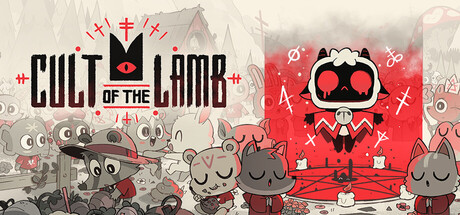
Do you like rogue-likes? Me too, but I’m far from good at them. When playing Dark Souls, I found the difficulty to be a barrier stopping me from enjoying it as much as I wanted to. This sucks, because the worldbuilding in these games, such as Bloodborne, is some of the best on the market. To this day, FromSoftware leads the charge in providing jaw-dropping settings, even convincing George R. R. Martin to work with them for Elden Ring.
However, one exception rises from the pits of combat hell to show me that it’s possible to make an accessible rogue-like, whilst keeping the challenge that the genre is known for. It crawls from the flames in the form of a lamb – how endearing.
To preface, this review is on the base game of Cult of the Lamb. There is a post-game DLC that expands greatly on other in-game content. For the sake of brevity, and since I have completed the game once without the Woolhaven DLC, I believe it would be best to stick with the barebones stuff in case anyone reading hasn’t got the extras.
Of course, with a subject as dark as running a cult, you would expect a game like this to take itself seriously, which it does at times. However, the publishers are Devolver Digital, known for games such as the chaotic banana shooter, My Friend Pedro. Therefore, I was expecting that I wouldn’t be getting a gritty, realistic base-building simulator. You play as a lamb, often referred to as ‘Lambert’ by the fandom. A quartet of mysterious deities have sent you to be executed, and you’re saved from this execution by an equally mysterious god with a thirst for vengeance. Your task is to get your revenge and pay back the dividends that come with being given a second chance.come with being given a second chance.
The gameplay loop consists of equal parts base-management and dungeon crawling. You build a cult from the ground up, saving and recruiting new members you find along your travels. The mechanics serve each other; you gain worship points that can be accumulated to buy combat buffs, and in return you gain resources in the dungeon areas to aid your cult. Food, wood, and stone are the essential three that you’ll find yourself scavenging for. Part of me wishes for more variety when it comes to materials, but it can be argued that the simplicity of wood and stone allows you to focus on other parts of the game. With these acquired resources, you can change and build up your cultish homeland however you want, with plenty of customisation options as you progress. Albeit that these are only affordable during the late game, which is a recurring problem I will tackle later. Overall, the simulation side is rewarding, fun, and engaging, as you can individually name and cater to each of your cult members.
I cannot emphasise how many options there are to customising your cult, down to the name and appearance of your devotees. You can collect a variety of animals, fish, crustaceans, and even Eldritch horrors that you can turn your cultists into! The game’s cutesy and unique art style adds to my need of making each of my cultists a silly little guy. This makes their deaths even more impactful, as it is rare for any of your cult to survive an entire playthrough. Each of them has their own lifespan, as well as myriads of ways for them to die, such as ritualistic sacrifice, starvation, and more.
You can also kill your own cultists too; rituals such as ‘Ascend Follower’ and ‘Sacrifice of the Flesh’ allow you to gain worship points by sacrificing a cult member of your choosing. You can either be practical by sacrificing those aged/near death, or you can take the petty route and kill those who have been a mild inconvenience. However, actions such as sacrificing cult members, or forcing them to continue their tasks can negatively impact their ‘faith’. The way this works is simple: if you disregard the needs of your cult, then their faith will go down. If left low enough, it can lead to some of your cult members dissenting. This causes a flaw as, if you are relatively good at any simulation game, you won’t find yourself worrying about members leaving.
Earlier, I praised the game’s accessibility within the genre, but Cult of the Lamb can feel like a cakewalk in terms of difficulty. In my playthrough, I chose the ‘normal’ difficulty setting, as I wanted the average player experience. Being good in the dungeon crawling aspect, I didn’t have to worry much for my cult. This sounds positive at first, right? Until I realise that many things haven’t unlocked before endgame, such as skill tree perks and doctrines. At this point, I have a cultist count so low you would think that I was running a book club. At this rate, I’d have to grind in endgame just to get everything that should have levelled with progression.
At times, I found myself slowing down my gameplay to not finish the game too quickly. The difficulty of the boss fights and dungeons do increase, but unless you count the final boss, there isn’t much of a harder skill gap. On one hand, you can argue that I should raise the difficulty. However, I argue that if you have to hinder yourself to make the game go slow but steady, then a bit of blame can be directed at the developers.
Don’t let this deter you from buying the game. I think that, regardless of the progression issue, the worldbuilding, customisation, base-management, and dungeon combat is plenty for you to enjoy it. The fact I want the game to slow down just shows how entertaining the game’s system is, and for that reason, I can only say one thing.
Baaaa.
Edited by Robin Smith





Leave a Reply