So maybe I am a little late to the scene with this one. In recent years the general acceptance of comics and Graphic Novels has gone up, and thus – obviously – the stigma has gone down. Schools, parents, librarians and Goodreads users are much less concerned about whether comics ‘count’ as reading material or not.
And yet, the stereotypes persist. What’s the first thing that pops into your mind at the mention of comics? Far too potent still is the image of scrawny teenage boys vying to overexplain why one Robin is better than the other, or the 35-year-old living in his parents’ basement between stacks of comic books and pizza boxes. The phrase ‘Graphic Novel’ isn’t quite so tainted – it calls up (to me anyway) hardback biographical comics or visual retellings of Shakespeare plays. But I don’t think there should be that dramatic of a difference. So, for the benefit of this article, they’re pretty interchangeable – sue me.
Let’s have a quick look at the benefits of comics more generally, since that’s where the discussion around them started. The classic example is that, being full of colour and movement instead of blocks of text (not to mention being much shorter than novels), comics are a good way for kids to get into reading who may otherwise struggle. Despite the reduction in words, they still aid comprehension and vocabulary, while the visual element demands the ability to decode, interpret and infer meaning, just as novels do. On top of that, they have proven helpful in improving social interaction or understanding emotions, and studies have been conducted on the positive impact they have on children’s mental health.
I could write about all this till my fingers fall off. There’s loads out there about all the ways that comics are good and should not be stigmatised, which is great.
So why do I still feel a prickle of embarrassment every time I make my way over to the Comics & Graphic Novels section in Waterstones?
Because all this comics talk is about kids. In trying to make them more acceptable, we have missed out a vital part of the comics world – just like with books, films, and the happy world of Haribo, children and adults alike can enjoy them. Sure, there are some targeted at specific age ranges – but the same is true for novels, with music, with TV shows, none of which have the discussion around them in quite the same way.
But maybe this doesn’t need to be said. If we go back to our basement-dwelling 35-year-old, it’s pretty safe to say that the comics he’s reading aren’t for younger readers. They’ll be hero comics full of violence and innuendo, just like Batman.
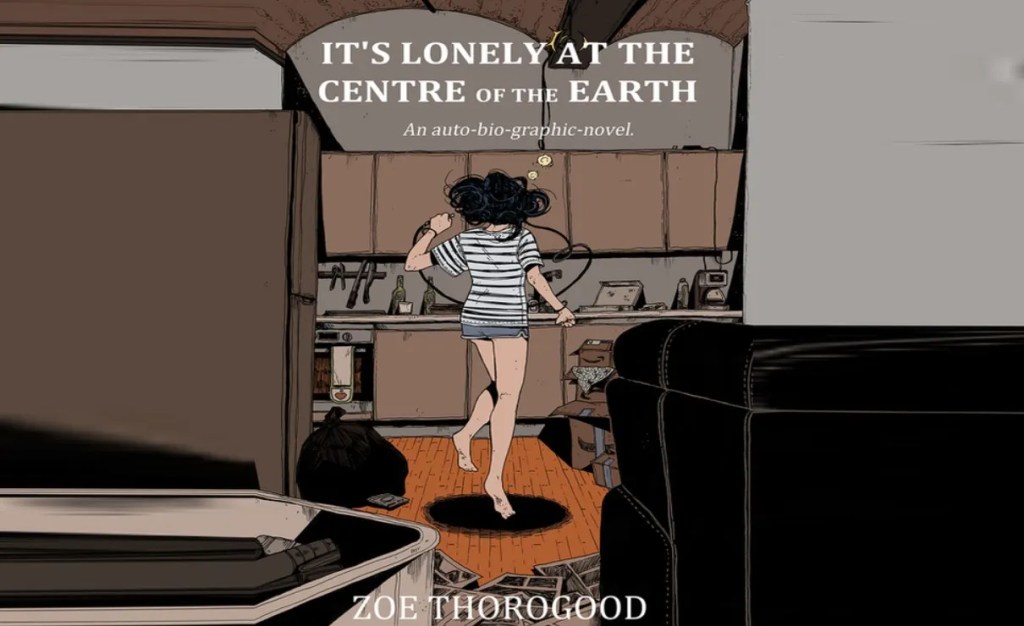
I hope to prove that there is far more to comics then what the stereotypes suggest. And to do this I want to highlight one example in particular: Zoe Thorogood’s It’s Lonely at the Centre of the Earth.
This story altered my brain chemistry. Its Goodreads reviews are divided between people who loved it and people who really didn’t, like the marmite of Graphic Novels. But Thorogood saw that coming, and in my opinion, its divisiveness is both part of the charm and part of the point she is putting across.
The comic explores Thorogood’s life, more specifically her struggle with depression. She lays the abstract on thick throughout the story, portraying her internal monologue with stylised characters, and depression as a creepy looming shadow hanging around in corners. It is a personal and deeply honest exploration into mental illness, creativity, and life. It’s higgeldy piggedly and stop-starty and messy, just like the human condition, and that’s what makes it so appealing to me. It touched nerves in me that no book ever has, in ways that straight prose never could – through playful yet considered drawings, full of depth and meaning.
This comic isn’t for the kids, and isn’t for Batman lovers either (not exclusively, anyway). But it is poignant, and powerful, displaying a message that should not be dismissed just because it is told through pictures.
And this is just one example of many such complex, personal and original comics, each with something to say as powerfully, if not more so, as books. We’ve made a good start of fighting the comic stigma, but it’s high time to finish the job.
Edited by Lydia Gallagher


Leave a Reply