Edited by Paige Wheeler and Jess Dunipace
“The big lie about the drug ‘community’” noted Kid Congo Powers, mythic guitarist in The Cramps and The Gun Club reflecting on his Berlin years, “is that everybody in the community is in fact completely isolated from everyone else, deep into their own trips.” Community presents a challenge to the artistically minded. The drive to create is often powered by a desire for connection, and is fuelled by the egoistic conviction that, against all odds, what you’ve made matters to the outside world. The trouble only creeps in when you try to prove it.
For a musician to scrape together their deepest thoughts, to struggle against their inner critics long enough to put them on tape (or a virtual plug-in simulation of tape on GarageBand) is tough. To then summon the energy and courage to play them to the kind of sympathetic, fidgety friends and colleagues you can browbeat into largely empty rooms as pounding house music and joyous screeching booms from elsewhere is doubly hard. The endless silence you project into can be tough gruel for the soul. Competition is written across gig posters in invisible ink. Why would musicians form a community? Why would you even leave your bedroom? Dwelling deep in your own trip can seem so appealing. Who, after all is listening?
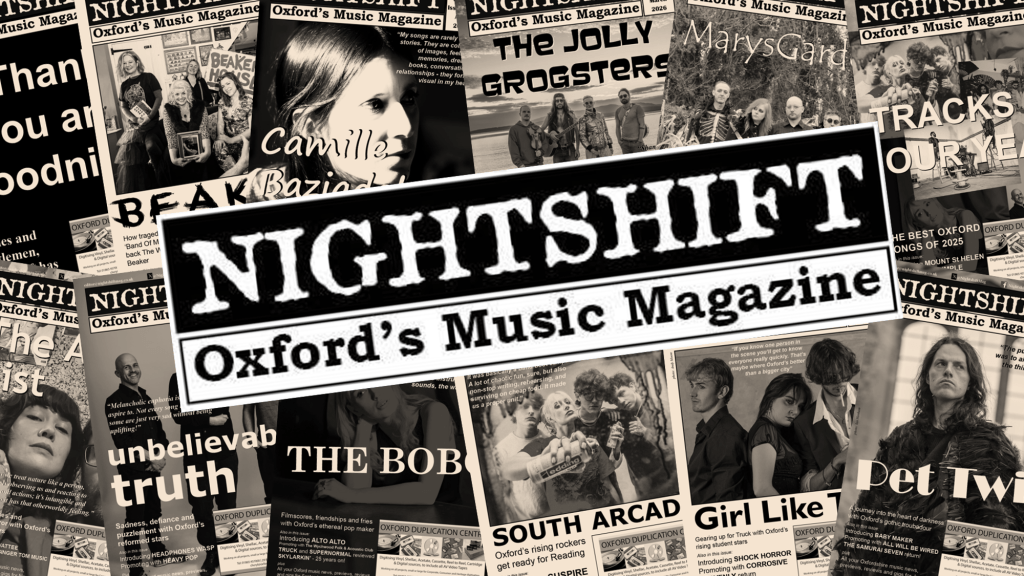
Sometimes then, music communities are formed and maintained in subtle ways, and not always by musicians. In fact, musicians are generally the last people that should be relied on for community building. Music fans and their projects – promoters, writers, merch volunteers, engineers, instead form an invisible mycorrhizal network that over time gives rise to the gradual, warm, realisation that the musicians of a city are in fact part of one pulsing organism. In Oxford a free magazine called Nightshift formed one of the strongest tendrils in that organism. In summer 2026 the city’s music scene is quietly reeling from news that this real, tangible, mostly offline object d’art has met its demise.
35 years is a long time to keep the wolf from the door. The life of an amateur musician is similarly full of siren calls to give up. My first year at university was spent slugging away in Turncoat, an indie band playing the worthy Britpop songs dreamt up by our buff, quarrelsome, barrister-in-waiting lead singer. No one danced. No one cared. One day the laconic, moustachioed bassist of our group bought me a beer and told me seductive tales of his earlier soul band in Wolverhampton. They played nothing but Stax soul music from the 1960s with a Midlands accent. People danced, they were constantly booked. So, we broke up the indie band, and I let the Devil guide me away from playing original music towards soul covers. Honestly, who was listening?
Over in Oxford, Nightshift was listening.
Their manifesto, if such a thing existed was to keep the city’s musicians inoculated to the poisons of jazz funk jamming and Coldplay cover bands. Tucked unassumingly in the corner of every cafe, barbershop and vinyl shop in Oxford, the always chiaroscuro, black and white presence spoke of another world lurking in the shadows of the city, a messy, punky DIY musical subculture still present amongst the gleaming spires. The covers belonged to excellently named local artists like Moogieman and the Masochists and Mandrake Handshake. It afforded attention and respect to those within its photocopied pages.
The photoshoots were creative and full of local landmarks. Why use a fish eyed lens when you could film a cover in an aquarium full of actual fish by the Cowley Road? The interviews were well informed and intriguing, allowing space for dreaming spires of thought. A cover star of the paper Camille Baziadoly described to me already missing “the care with which they listened. The sense of community. Nightshift was like a reliable friend.” Another duo Barricane, proudly showed me their Nightshift cover framed and hung over the fireplace being slowly overtaken by an intrepid monstera plant. The subtext to every neatly folded, matte edition was that THIS was the scene. The pubs and communal spaces and wet grassy fields of Oxford were the stage. Not a staging post for future success. This was a scene. A little gritty sure. A little parochial, guaranteed. But self-sufficient, proud and ever changing. An organism. Nightshift was a mulch from which some fairly sturdy plants grew. Some you might have heard of.
If you stand outside the gleaming John Lewis in the smart open-air Westgate Centre now, you might hear the rustle in the wind of the ghosts of the older, grimmer, claustrophobic Oxford shopping centre in whose bones it was built. I remember post university excitedly ducking under the blocky triangle entrance to the centre and stepping into a boxy, anonymous CD shop called Our Price under the murky lighting. I was excited because I knew that it was in this shop a few years prior, that two workers chatting about music would put Oxford more firmly on the music map. One was Ronan Munro, editor of the nascent Nightshift then called Curfew. The other Ed O’Brien guitarist in the nascent Radiohead, then called On a Friday. The magazine interviewed the band. On a Friday became Radiohead. The editor went on to review, at his count nearly 4,000 more local bands.
His manner was not always kind, reflecting as it did the colourful combative style of the Britpop era NME and Melody Maker, where writers like Steven Wells cheerfully tore into young bands like Rottweilers Chewing Wasps. The ‘demo hell’ section was written by the editor himself and as a court was entered only with a mix of bravery and trepidation. On the last issue he promised himself “a litre of cooking brandy that’s whispering my name” if he made it through to the end of the pile. By the 20th entry he was describing a funk band as ‘widdly wanky woo.’ But beneath the amusingly descriptive vitriol there was the simple fact that HE was listening. His critiques were well informed and most importantly deeply curious. Reviews of my own band in the pages over 10 years compared me to everything from plinky plonky toytown cassettes to awkward baby giraffes. But also, on recently rereading those little reviews, a brusquely encouraging tone emerged with comparisons to an assemblage of surprisingly accurate artists and bands that inspired me. Nightshift got it.
Kid Congo Powers became a cult legend through his untutored, lascivious garage guitar playing in the 1980s. Before that, though, he wrote for a local punk fanzine, describing the urge to be “eager to be close to the music, wanting to be facilitators of making something happen, whatever that would be.”
So goodnight, Nightshift. You were a tendril in an invisible network of music fans, informing, entertaining, interrogating and revelling in the uniquely expressive world of underground music. In a changing musical landscape full of online snake oil, exhausted, oversaturated platforms, and musicians still wondering whether anybody cares, perhaps more than ever, you shall be missed.
Nightshift lent the city an ear.






Leave a comment