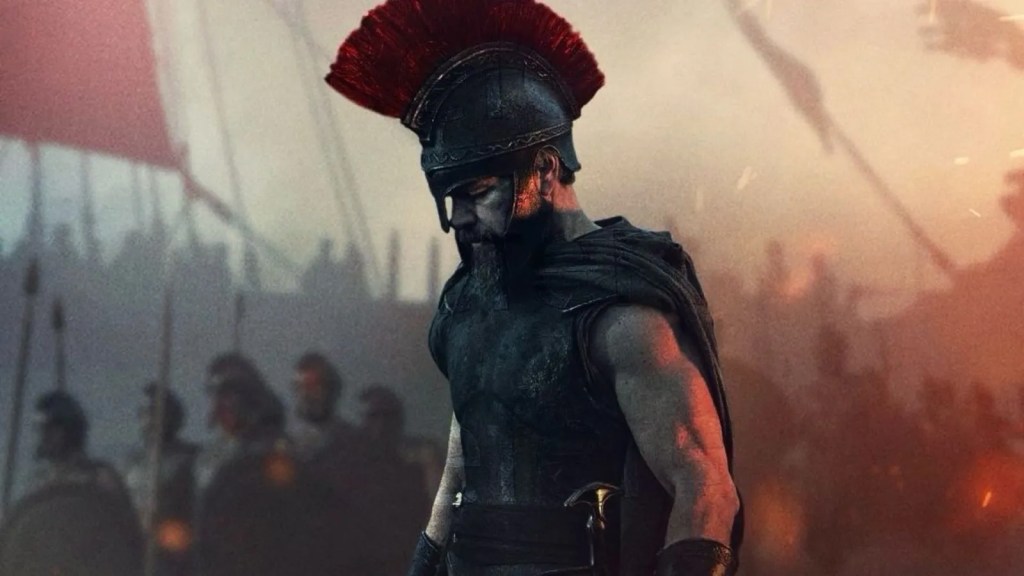
Can a 3,000-year-old poem still captivate modern audiences? Christopher Nolan’s The Odyssey does not just try to answer that question, it boldly transforms one of history’s greatest epics into one of this year’s most ambitious cinematic events. With enormous expectations surrounding the film, Nolan’s latest release must do more than simply retell Homer’s tale; it has to convince audiences that an ancient myth can still feel urgent, emotional, and spectacular in 2026.
From its vast IMAX visuals to its commitment to the physicality of practical filmmaking, The Odyssey feels less like a story being brought back from the past but more like one being experienced for the first time. Yet, beneath its enormous ambition lies a film that occasionally feels slightly clunky, preventing it from quite reaching the precision and emotional impact of Nolan’s absolute best work, such as Inception and Interstellar.
At its heart, The Odyssey is a story about getting home. Following the Trojan War, Odysseus begins the long journey back to Ithaca, only to face an endless series of obstacles. Gods, monsters, temptation, and the unpredictable forces of the sea stand between him and his home, while those he has left behind are forced to reckon with his absence.
For a story that has survived for almost 3,000 years, its premise remains remarkably straightforward. Yet that simplicity is deceptive. Homer’s epic is enormous in both scale and influence, filled with stories and characters that have been retold countless times. Nolan therefore faces a difficult task: how do you take one of the oldest stories in Western literature and make audiences feel as though they are discovering it for the first time?
The answer is not to strip away what makes The Odyssey ancient, but to embrace it. Nolan builds a world of enormous scale around the mythology, allowing its gods, monsters, and legendary encounters to feel like events made for the cinema.
The first thing that makes The Odyssey work is its sheer scale. This is a film designed for the biggest screen possible, with sweeping landscapes, enormous set pieces and an atmosphere that makes Homer’s world feel physically present. Watching it in IMAX only amplifies this effect. Nolan understands that a story this epic cannot feel small, and the film rarely allows it to.
Much of that scale comes from Nolan’s approach to filmmaking itself. At a time when digital effects and increasingly sophisticated computer-generated imagery can create anything imaginable, The Odyssey has a striking physicality. The world feels built rather than simply generated. This is particularly effective in its more fantastical moments, giving the monsters, landscapes, and dangers a sense of weight that makes Odysseus’ journey feel genuinely perilous.
For all its ambition, The Odyssey is not as flawless as its scale might suggest. At times, the film feels slightly awkward, particularly when shifting between enormous set pieces and quieter character moments. There is so much mythology to fit into one film that some sections can feel as though they are moving from one major event to the next rather than allowing each moment enough time to settle. A notable example of this: Circe is also misunderstood, portrayed as a cruel witch rather than the complex character explored in later interpretations such as Madeline Miller’s Circe.
This is where The Odyssey falls slightly short of Nolan’s absolute best work. Inception and Interstellar managed to combine enormous concepts and spectacular filmmaking with a strong emotional core, making the most ambitious ideas feel surprisingly intimate. The Odyssey achieves much of the same spectacle but does not always reach that same level of precision. Its ambition is impressive, but occasionally it feels as though the film is struggling under the weight of the story it is trying to tell.
The most surprising thing about The Odyssey is how little its story has aged. Strip away the gods, monsters, and mythical islands, and at its centre is something remarkably familiar: a person trying to find their way home. Loyalty, grief, temptation, perseverance, and the desire to return to the people we love are not uniquely ancient ideas. They are human ones.
Nolan’s adaptation succeeds because it does not need to force these themes into a modern setting to make them relevant. Instead, it allows the original story to speak for itself. The technology surrounding the story may have changed dramatically, but the questions at its centre have not. After almost 3,000 years, they are still modern enough already.
There is something almost inevitable about Christopher Nolan making The Odyssey. Few contemporary directors are as interested in turning enormous ideas into grand cinematic experiences. His films repeatedly explore time, memory, identity, sacrifice, and the limits of human endurance – all ideas that sit naturally within Homer’s epic.
That makes The Odyssey more than an adaptation of an ancient poem. In an era of streaming, artificial intelligence and increasingly digital filmmaking, Nolan has created a film that demands to be experienced as an event. Its scale, sound and imagery are difficult to separate from the experience of watching it in a cinema. In an age when almost everything can eventually be watched from a sofa, Nolan has made a film that makes leaving the house feel like part of the experience.
So, can a 3,000-year-old poem still captivate modern audiences? Despite its occasional clunky moments, The Odyssey proves that it can. Nolan has taken a story that has survived for thousands of years and given it the scale, spectacle, and physicality of modern cinema without stripping away the qualities that made it endure in the first place.
It may not reach the emotional precision of Interstellar or the narrative ingenuity of Inception, but what The Odyssey achieves is remarkable. 3,000 years after Homer first told the story of Odysseus, Nolan has found a way to make audiences listen again. And that is the greatest achievement of all: not making an ancient story modern but reminding us that some stories never really become old.
Katy Galloway
Edited by Robin Smith
Subedited by Petra Holloway


Leave a Reply