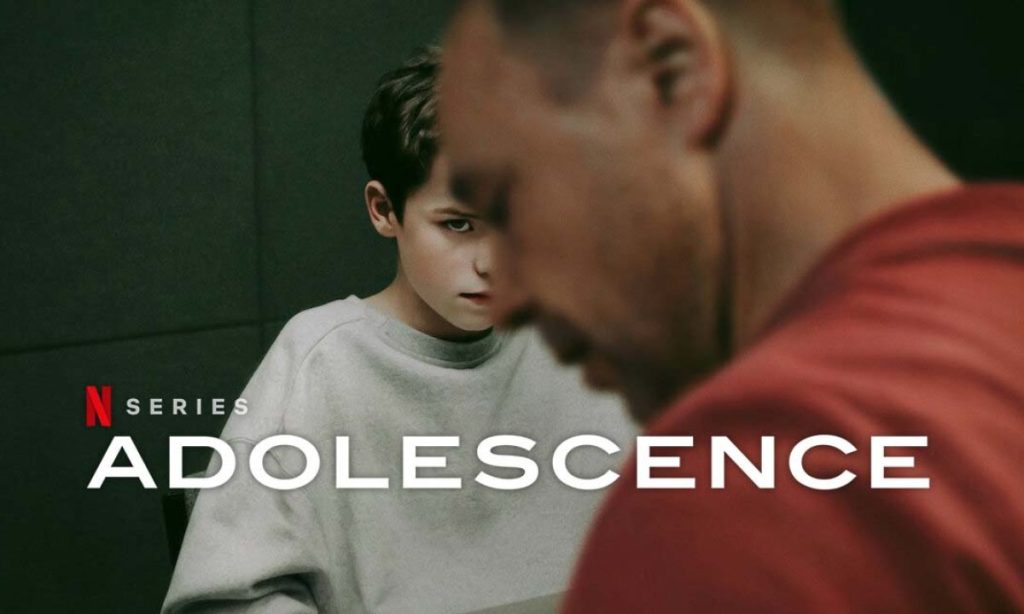
In the digital age, adolescence unfolds not just in classrooms and homes, but increasingly on screens. For teenage boys, coming of age has become a fraught journey, shaped as much by YouTube algorithms and TikTok influencers as by peers or parents. Netflix’s eye-opening series Adolescence taps into this worrying progression, offering fictional but scarily recognisable portrayals of teenage boys grappling with identity, belonging, and masculinity.
As young, male characters in the show stumble through school hallways and locker rooms, they also begin to navigate, in their bedrooms lit by the glow of smartphones, a less visible, but equally powerful, space: the online world of the manosphere. This network of toxic subcultures, such as incels and ‘Red Pill’ philosophers, is increasingly shaping how young men think about everything, from gender to power. Some enter seeking guidance, others, a sense of control in a world that feels alienating or unjust.
This article explores how Adolescence reflects and echoes the real-life influence of the manosphere on teenage boys today. How accurately does the series portray the allure, and danger, of these digital ideologies? What does it reveal about the emotional voids that lead young men online? And what does it suggest about how society should respond?
The manosphere is ‘a conglomerate of Web-based misogynist movements focused on men’s issues.’ While it includes a spectrum of perspectives, the manosphere is united by one common belief: that contemporary culture is somehow hostile to men. Originating on forums like Reddit and evolving through platforms like Discord, the manosphere is no longer a simple ideology, but a patchwork of subcultures. Each appeal to young men in different ways, particularly during adolescence, when questions of identity become most acute. There are many movements involved within this community, such as ‘The Red Pill’ and incels. The Red Pill refers to ‘ a “subreddit” that is explicitly devoted to a “[d]iscussion of sexual strategy in a culture increasingly lacking a positive identity for men.’ This philosophy (based on The Matrix) appears to promote self-improvement and a sense of belonging, but this smokescreen simply hides the hatred for women that connects these misogynists. It encourages men to ‘wake up’ to what they claim are harsh truths about gender. It teaches them that modern feminism has skewed sexual and social dynamics in favour of women, and that men must reclaim dominance through strategic manipulation of relationships. Perhaps the darkest and most infamous corner of the manosphere, incels refer to the involuntarily celibate men who express anti-feminist views, perhaps to cope with their rejection. Their forums are often echo chambers of despair, anger, and in some cases, calls for violent retribution against women.
To an adolescent boy navigating insecurity, rejection, or confusion, these spaces can offer a seductive structure. They present themselves as truthful counter-narratives to the ‘feminised’ mainstream culture, offering community and purpose in exchange for an ideological buy-in. Crucially, the manosphere is not confined to obscure forums anymore. Its language terms like ‘simp’, ‘alpha’, and ‘beta’, have permeated mainstream social media and pop culture. Teenagers often use these terms uncritically, but their origins and implications are anything but harmless.
As Adolescence shows young characters engaging in the digital space, scrolling through influencers, watching viral videos, or joining group chats, it indirectly illustrates how quickly dangerous ideologies can hijack a teenager’s search for guidance. Understanding the manosphere is key to understanding what kind of digital guidance today’s boys are receiving, and what voids these spaces are filling.
While Adolescence never directly mentions the manosphere, its presence is felt throughout the series. Through characters like Jamie’s, the show explores how teenage boys, facing rejection, confusion, and emotional isolation, are drawn into online spaces that promise clarity. Jamie serves as the clearest window into how teenage boys can get drawn into the manosphere. Quiet, socially awkward, and often overlooked, Jamie initially comes across as a regular, shy teen attempting to find his place. But as the season progresses, we watch his online life take centre stage through late-night YouTube binges, algorithm-driven content, and parasocial connections with male influencers who promise to help explain his frustrations. After being embarrassed in front of his fellow peers and being ‘ghosted‘ by a girl he is interested in, he finds comfort in videos that frame rejection not as bad luck, but as proof of deeper societal truths. These videos express that modern relationships are rigged, that men like him are ‘losing’, and that the solution is control, violence, and dominance.
The shift throughout the series is subtle but present. He begins parroting terms like ‘simp’ and ‘high-value male’ with a smirk spread on his face. His tone toward female classmates grows colder. But rather than painting him as a villain, the show makes clear that Jamie is a product of neglect, emotionally distant parents, a school system that does not ask questions, and a digital world more than happy to fill in the gaps. The manosphere often attracts boys through recognition, not always through rage, the common assumption. Adolescence uses Jamie to show just how easy, and how dangerous, their promise can be.
One of Adolescence’s greatest strengths is its nuanced depiction of online ideologies that quietly infiltrate teenage life. Through Jamie and others, the show captures the emotional vulnerability that drives many boys toward the manosphere. This includes the sting of romantic rejection, the need for validation, and the discomfort of not fitting into mainstream ideals of masculinity. It does not sensationalise or exaggerate the process of radicalisation. Instead, it shows how these beliefs evolve slowly, often under the radar of adults. The way social media platforms serve as recruitment tools is one of the many things the series does well. Jamie is not seeking extreme material, it finds him in inspirational videos, likable influencers, and comment sections full of people who share his frustration. This is similar to real-world situations where algorithms frequently direct users towards more extreme content under the pretence of related videos, often promoting self-improvement. It also succeeds in portraying how these ideas affect not just online behaviour, but real-life relationships. Jamie begins to pull away from friends, speaks more dismissively about girls, and views the world through an increasingly rigid ‘us versus them’ viewpoint. His interactions grow colder and more performative as if he is testing out a persona from what he has absorbed online.
However, the show is not without its blind spots.
Whilst Adolescence effectively illustrates the emotional and digital environment that fosters these beliefs, it largely skirts around larger structural issues. For example, it rarely interrogates the economic, racial, or class dynamics that can influence how and why certain boys are more susceptible to manosphere ideologies. The series also only lightly touches on the community dynamics within manosphere spaces. In real life, the appeal is not just through visual content, but the forums, comment sections, and group chats that promise a sense of brotherhood. Jamie’s experience is mostly independent, which is emotionally resonant but misses the crucial role of group reinforcement and peer validation in online radicalisation.
Another gap is the lack of visible counter-narratives. Aside from one or two sympathetic characters, there is little to suggest alternative paths for boys like Jamie (no mentorship, no emotionally intelligent male role models, and no clear rebuttal to the toxic ideologies he is absorbing). While this might reflect the bleakness of many real-world situations, it also leaves viewers without a strong sense of what a constructive intervention may look like. Some viewers have also expressed that by viewing media texts that label men as ‘toxic’ and ‘controlling’, they are being pushed towards the manosphere as it is the only place in society that is not belittling them. While this series may have created some upset for male viewers, it importantly highlights that these harsh realities must be faced. Whether you want to accept it or not, men do commit a significant number of crimes towards women; to be exact, a woman is killed by a man every three days in the UK. In 2024, the toll of women whose deaths have led to a man being charged has reached 80. And, over the last decade, there were 898 female victims of domestic homicides, of these, 698 victims (78%) were killed by a partner or ex-partner.
“Men don’t want to be told they are “toxic”. By constantly putting men down, society is driving young men to be influenced by people such as Tate, as they see no approval from anywhere in their life.” Justin, 22, self-employed, Melbourne
“It was chilling to see a real-life look into the effects of social media and cyberbullying on my generation and the next… I was bullied as a kid and I can only imagine the impact it would’ve had on me if I had been on social media at the same time”. Calden, 21, student, Boston, Massachusetts
Ultimately, Adolescence nails the emotional truth of how boys drift toward the manosphere but does sometimes miss the social and political complexity behind it. Still, in highlighting the subtle and humane motivations behind the ideological shifts, it opens the door to a much-needed cultural conversation, not just about what is happening to teenage boys, but why, and what we can do about it.
Adolescence does not offer easy solutions, but that is part of its value. It reflects a growing cultural awareness that the crisis of young masculinity is not just a phase or an internet quirk, but a complex social challenge that demands thoughtful engagement. If boys like Jamie are being shaped by the manosphere, the question alters; what else is shaping them? The first step is acknowledging the emotional reality hidden in the manosphere’s appeal. These online communities speak to boys who feel ignored, shamed, and disempowered. Dismissing them as simply ‘toxic’ or ‘fragile’ does not address the deeper issue: a widespread failure to give boys tools for emotional literacy, healthy connection, and a sense of purpose. Key interventions could include: reimagining masculinity, increased male mentorship, and more accessible mental health services. The lack of male teachers/leaders, access to support, and lack of definition of masculinity are enabling the deterioration of young teenagers’ mentality towards women. What Adolescence subtly suggests is that intervention does not start with censorship or blame, but with presence. Listening, noticing changes, and offering consistent emotional support can interrupt the trajectory before it deepens into ideology.
Adolescence may be a fictional series, but it taps into a very real, cultural fault: the growing disconnect between young men and the society around them. As we follow Jamie’s arc, what we are witnessing is a broader crisis of identity. It raises the question, what does it mean to be a man in today’s world? The manosphere offers a distorted answer. It fills the silence left by absent role models, fractured infrastructure, and a culture that often treats boys’ pain as humorous or threatening. By putting a character like Jamie at the centre, the series reframes the manosphere as a deeply human issue as opposed to an abstract, online fault. It reminds us that these ideologies are symptoms of deeper issues like emotional isolation and a hunger to belong. If these needs go unmet in healthy spaces, they will be met somewhere else, in the darkest corners of the internet.
Adolescence invites us to address the hard questions. Instead of simply querying how to stop boys from going down these paths, we need to ask why they feel as though no one is listening to them. In doing so, it challenges us, as parents, educators, and peers, to become the voices that speak before the algorithms do.



 Splendid Fred Magazine
Leave a comment