Ever since Mary Shelley founded the science-fiction genre in 1818 with her novel Frankenstein, the writing genre has boomed, and along with it, has adaptations. The 1931 adaptation of Frankenstein featuring Boris Karloff as The Monster is widely regarded as both one of the best Frankenstein adaptations and sci-fi adaptations in general. Other notable mentions include Steven Spielberg’s War of the Worlds and Denis Villeneuve’s adaptation of Arrival. But what makes a book-to-film adaptation good? Why is sci-fi so hard to adapt for the screen?
The most obvious answer is, of course, in the name: science-fiction. ‘Science’, but it’s made up. In school, I was hopeless at science (never ask me to balance equations or how to calculate aerobic respiration), but I do know that a bolt of lightning isn’t going to reanimate a corpse made out of a bunch of other corpses. Hopefully. The basis of sci-fi is that it isn’t real (of course, hard sci-fi is grounded in real life but that’s a whole other can of worms I don’t have the word count for).
The point is: it’s hard to adapt from the imagination. I’ll use an example that isn’t Frankenstein — Dune. Famously hard to get right on the big screen (even David Lynch’s 1984 version failed), Dune encompasses such a vivid world, it’s almost impossible to translate from the mind. After all, how can anyone approximate what the universe will look like in 10191? Dune’s author, Frank Herbert, does grant us the small mercy of creating a space-age feudal system. We at least have a basis for that.
What is harder to visualise, however, are the giant sandworms. 400 metres long with razor sharp teeth, it’s difficult to conceive such a mass. Lynch’s interpretation was just really big worms, with really wide mouths. It may be the dated special effects, but the worms are particularly goofy. The natives of the sandworm planet use the worms’ teeth as blades for their weapons. In the 1984 version, we have a close-up inside the mouth, revealing a slightly sparse, evolutionarily impractical array of spikes that don’t pierce me with fright.
In all honesty, many people have pointed out that in the most recent Dune adaptation, also by Villeneuve, the worms resemble something more… natiform. Despite this, I think these worms are much scarier than Lynch’s. Their teeth are all-consuming; the sole focus. It also makes sense evolution-wise — the baleen whale also has a terrifying amount of long, thin teeth to filter water from food, the same way the sandworms filter through sand.
Whilst special effects are, of course, not the only test of a good film, and Lynch’s Dune came out 40 years ago, Villeneuve did an excellent job of creating something truly daunting. Drawing upon the real world and real animal characteristics means that the sandworms turn into a creature that could actually exist.
Another reason why sci-fi film adaptations often fall short of their books is due to plot changes. Andy Weir’s The Martian is my favourite example. Although the film does stay pretty much true to the book, it was unfortunately made in 2015. This was around the superhero film Golden Age, with films like The Avengers, X-Men, and Suicide Squad coming out at similar times. The biggest, and worse, difference to me is the ending.
For those of you who haven’t read/watched The Martian (go do it as soon as you finish reading this article; I promise you’ll love it, but be warned I will be writing spoilers), it’s about an astronaut called Mark Watney. Whilst on Mars with his crew, there’s a sandstorm (no sandworms, unfortunately) that forces the crew to evacuate the mission. Watney is hit by debris, leaving his crew to believe he is dead. They leave Mars without him but, surprise, he’s still alive! He then has to survive Mars alone, with no way of contacting help.
They manage to get him back, though. After 330 pages of pure stress and anxiety, his crew are able to rescue him. In the film, it’s a strange sequence of events. Watney is determined to ‘Iron Man’ his way out of his shuttle to his crews’ ship, by puncturing a hole in his spacesuit and using the momentum to steer himself towards the ship. It’s a stupid idea, obviously. The commander, using the tether, pulls him back onto the ship. Although it creates a beautiful visual, it is an unrealistic end to an otherwise very grounded, hard sci-fi plot.
The book ends differently. There are no annoying heroics from Watney. The ship’s surgeon, Beck, uses the tether, but floats out to Watney to grab him. It is very simple, but very effective. Beck simply latches on to the tether clips of Watney’s suit, and another crew member pulls them in. Both versions, admittedly, show the beauty of human support and connection. But I think, in this instance, the book does it better.
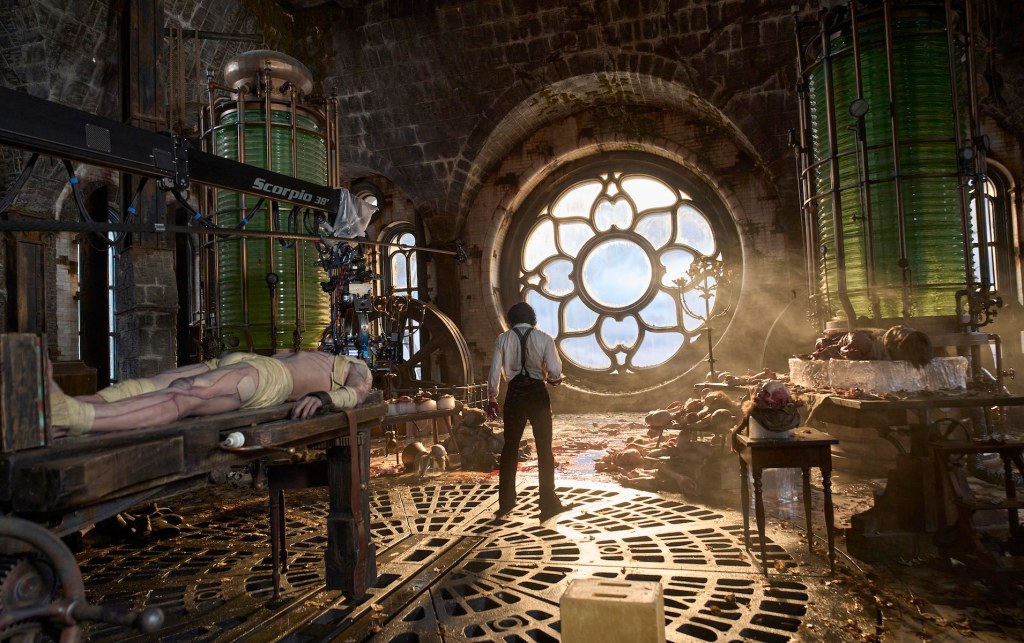
Frankenstein adaptations are countless, and my favourite has to be the 2015 Victor Frankenstein, which features James McAvoy as the titular character (yes, McAvoy is my favourite actor; no, I am not biased). It is absolutely terrible, and nothing like the book, but McAvoy is compelling. His Dr Frankenstein is wild, changeable, larger-than-life, and, despite yourself, you are drawn into the ridiculousness of the story. You hate his arrogance; love his brilliance; feel for his downfall even though he brought it upon himself. With as many Frankenstein film variations as there are (nearly 200 as of writing), I can see why filmmakers take the vague concept of such a complex, well-known and well-loved novel and make it their own.
Boris Karloff as The Monster in the 1931’s adaptation is the most famous for a reason. Lurching, awkward, and subtly endearing, he perfectly represents the themes of Shelley’s work. There is an innocence to him at the start of the film, which hurts to watch as it is corrupted. His stilted, tentative yet purposeful movements set up the inevitable tragedy that is Frankenstein.
So, what makes a good sci-fi adaptation? To me, the best adaptations stay true to their book’s plot and themes, and use the sci-fi genre to their advantage. Even though we all visualise things differently, sci-fi is, fundamentally, science. Things that are grounded in reality. Between wacky worms, annoying plot changes, and completely revamping a classic, there will always be something wrong with an adaptation. But, that leaves all the more room for interest and enjoyment — getting to experience the book you love with a new perspective.

 Splendid Fred Magazine
Leave a comment